In today’s digital age, where fiber optics and 4G/5G are prevalent, there are many remote areas where it is impossible for electricity or network cables to reach. For such places, satellite internet is nothing less than a blessing.
In today’s post, we will learn what satellite internet is and how it provides us with internet from space.
What is satellite internet?
Usually, we get internet through underground cables, but with satellite internet, your connection is directly with satellites present in the sky. In this, data goes from the ground into space and then back to your home.
How does it work?
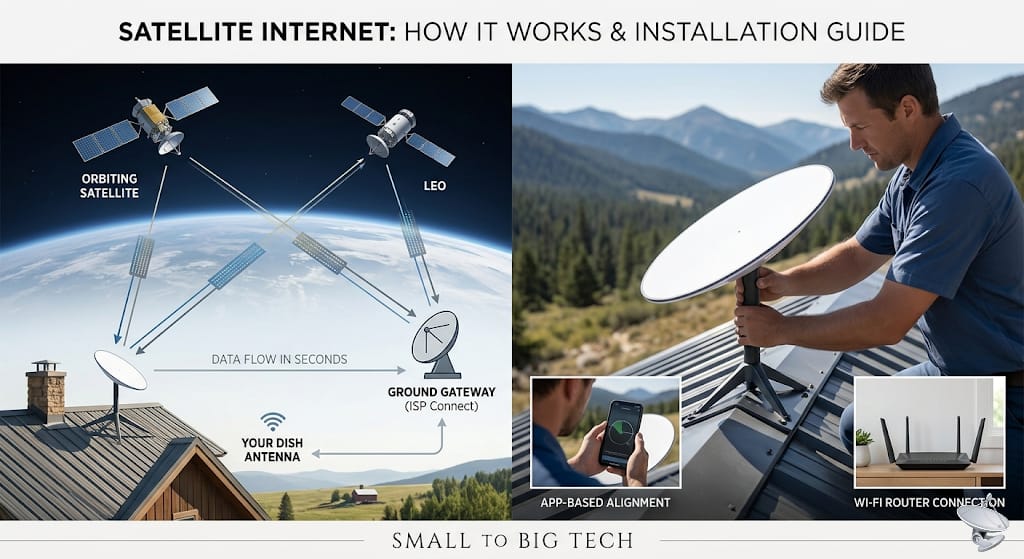
The entire system of satellite internet consists of three major parts.
- Satellite: These are orbiting thousands of kilometers above the earth.
- Gateway: This is a large center on the ground that sends data from the internet provider to the satellite.
- Your dish antenna: This is installed on your roof, which receives signals from the satellite.
- Process: When you search for a website, your computer sends a signal to your dish, the dish sends it to the satellite in space, the satellite sends it back to the gateway on the ground, and from there, the data comes back to you. This entire process happens in just a fraction of a second.
How is it installed?
The installation of satellite internet is very simple, and most companies like Starlink provide it with a “Do-it-Yourself” kit:
- Choosing the location for the dish: Choose a spot on the roof where the view of the sky is completely clear; trees or walls should not obstruct the signal.
- Installation: Securely mount the dish on a special stand.
- Connection: Connect the cable coming from the dish to the “Wi-Fi router” in your home.
- Alignment via app: Most modern systems have a mobile app that tells you the angle at which to place the dish to get the best signal.
Pros and Cons of satellite internetPros:
Available in any remote mountainous or rural area.
Freedom from the mess of wires.
Cons:
- Latency: It takes some time for data to travel to space and back, so it is not suitable for high-speed gaming.
- Weather effects: Signal quality can be affected during storms or heavy rain.
Is it for you?
If you live in an area where fiber or cable facility is not available, then satellite internet is your best companion. But if you live in a city where fiber optic is available, then fiber is still cheaper and faster than satellite.
Are you ever thinking of using satellite internet? Share your thoughts in the comments!
Stay connected with Small to Big Tech for more interesting information from the world of technology.