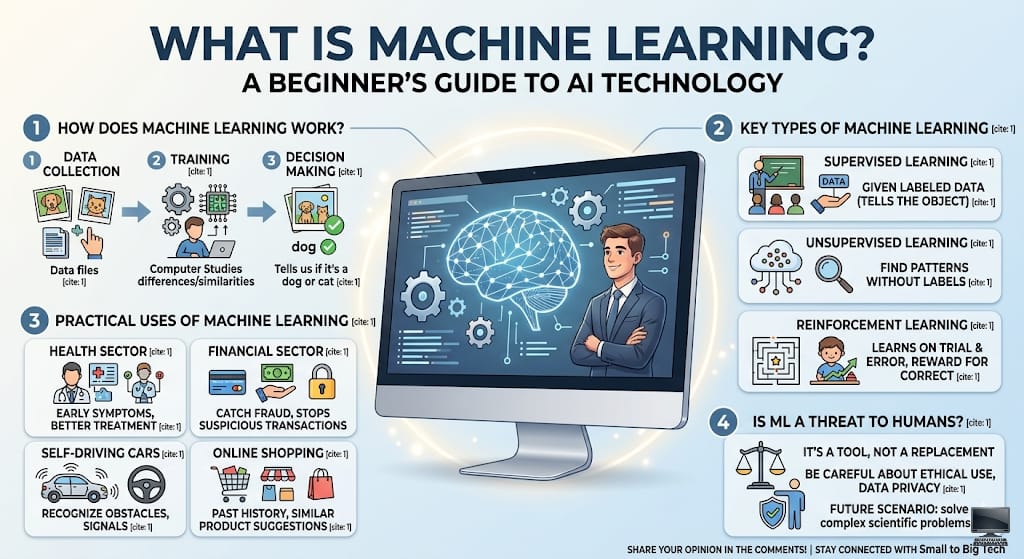
In today’s digital age, we are influenced by artificial intelligence every moment. When you watch a movie on Netflix and it suggests similar movies to you, or when Facebook automatically recognizes people in your photos and suggests tagging them, a powerful technology is at work called “Machine Learning.” Machine learning is actually a branch of artificial intelligence that enables computers to learn from data and make decisions without specific programming.
Basic concept of Machine Learning
Usually, a computer has to be given detailed instructions or programming code for any task. But in machine learning, instead of giving direct instructions, we provide the computer with “data.” The computer analyzes this data, finds patterns within it, and learns from experience. The more information we provide, the more expert it becomes in its work. This is exactly how a small child learns from experiences.
How does Machine Learning work?
The process of machine learning can be understood in three stages:
- Data Collection: First, a lot of raw data is given to the machine to learn. For example, if we want to teach a machine to recognize a dog and a cat, we will give it thousands of pictures.
- Training: The computer studies these pictures and finds the differences and similarities in them. It learns what a cat’s ears look like and what a dog’s shape is.
- Decision Making: When the training is complete, we give it a new picture, and based on its learned experience, the machine tells us whether it is a dog or a cat.
Key types of Machine Learning
Machine learning is basically divided into three methods:
- Unsupervised Learning: In this, the computer is given data without any labels, and it finds patterns itself.
- Supervised Learning: In this, the computer is given labeled data. That is, we also tell it what the object is.
- Reinforcement Learning: In this, the machine learns on the principle of “trial and error.” For every correct decision, it gets a reward, and on an error, it changes its strategy.
Practical uses of Machine Learning
Machine learning is now being used in every field:
- Health Sector: Doctors can now better understand the early symptoms of diseases with the help of machine learning and make better decisions for patient treatment.
- Financial Sector: Machine learning is used to catch fraud in banking. If there is a suspicious transaction from your credit card, the system immediately stops it.
- Self-Driving Cars: Automated cars use machine learning to recognize obstacles, traffic signals, and pedestrians on the road.
- Online Shopping: E-commerce companies look at your past purchase history to show you products that you are interested in.
Is Machine Learning a threat to humans?
Many people think, will machines take over humans? The reality is that machine learning is just a tool. It is meant to make tasks easier and faster, not to replace humans. However, we need to be very careful about the ethical use of this technology. Data privacy and algorithm transparency are important topics being discussed globally.
Future Scenario
The future of machine learning is very bright. In the coming times, we will see systems that can understand human emotions, predict the weather accurately, and solve the most complex scientific problems in a snap. This technology will completely change the way we live.
Conclusion
Learning machine learning is the most important demand of today’s era. If you want to build a career in the IT or technology field, understanding the basic concepts of machine learning will be extremely helpful for you. It is not just coding; it is a new way to understand and improve the world.
Do you think machine learning is interfering too much in our lives? Or is it necessary for progress? Let us know your opinion in the comments.
Stay connected with Small to Big Tech for new trends and learning opportunities in the world of technology.