In the world of computers, if any single tool has made human interaction the easiest, it is undoubtedly the “computer mouse.” Today, we don’t think twice while clicking on any icon on the screen, but have you ever considered the stages this small device has gone through from its early days to today’s laser technology? In today’s post, we will tell you about the history and the interesting journey of the computer mouse.
The Beginning of the Computer Mouse
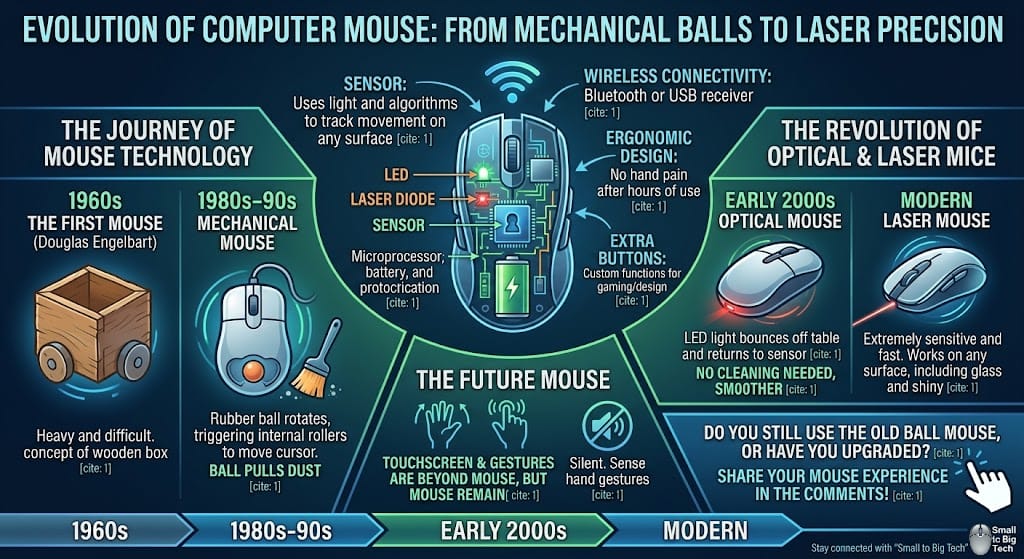
The concept of the computer mouse was introduced in the 1960s by Douglas Engelbart. The first mouse was made from a small wooden box with two wheels underneath. This mouse was used to move the cursor on the computer screen, but at that time, it was considered a very heavy and difficult device. At that time, no one thought that this device would become a basic necessity for every computer in the future.
Mechanical Mouse: The Era of the Ball
In the 1980s and 1990s, the mouse we saw the most was the “mechanical mouse.” This mouse had a rubber ball at the bottom that would rotate on the surface. As we moved the mouse on the table, the ball inside would rotate, which would trigger the small rollers inside, and the cursor would move on the screen.
Problems with this mouse: Although this mouse was quite functional, it had some major issues. The biggest problem was “dust.” The ball would pull dust and hair from the table inside, which would sometimes cause the mouse cursor to freeze or become erratic. Therefore, taking out the mouse ball and cleaning it every once in a while was a mandatory task.
The Revolution of the Optical Mouse
At the beginning of the 2000s, the world welcomed the “optical mouse.” In this mouse, the ball was replaced by a small light (LED) and a sensor. This light would bounce off the table surface and return to the sensor, which would let the computer know in which direction the mouse was moving. This change eliminated all the problems of the mechanical mouse. Now, the mouse no longer needed cleaning, and it became much smoother than before.
Laser Mouse: The Rise of Modern Technology
After the optical mouse, the “laser mouse” stepped in. Laser technology is much more sensitive and faster than optical. The biggest advantage of a laser mouse is that it can work on almost any surface. While an optical mouse is unable to work on glass or very shiny surfaces, a laser mouse works with extreme precision. This is why a laser mouse is still the first choice for gamers and graphics designers today.
Modern Features in a Mouse
Not just limited to movement, the evolution of the mouse has now reached buttons and wireless technology. Today’s modern mice include:
- Wireless Connectivity: Wireless mice via Bluetooth or USB receivers have now become common.
- Ergonomic Design: The design of the mouse is created in such a way that there is no pain in the hand even after hours of use.
- Extra Buttons: Gaming mice have many extra buttons that can be set for functions of your choice.
The Future Mouse
Technology is now moving beyond the mouse to touchscreens and gestures, but the utility of the mouse remains. In the future, we will see mice that are completely silent and perhaps some that can sense your hand gestures in the air.
Conclusion
The journey of the computer mouse started with a wooden box and has reached laser beams. This journey teaches us that technology never stops; instead, it becomes simpler, faster, and more efficient with each passing day. Whether you are a student or a professional, your mouse is the hand that keeps the digital world under your command.
Do you still use the old ball mouse, or have you upgraded? Do share your mouse experience in the comments!
Stay connected with “Small to Big Tech” for new trends and learning opportunities in the world of technology.