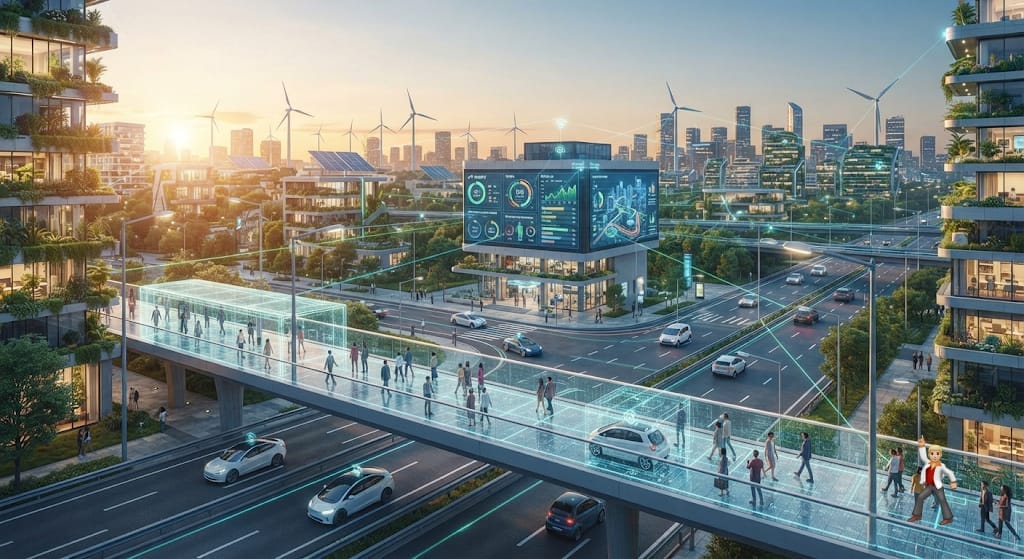
In today’s rapidly developing world, humanity is making new and innovative inventions day and night to make life easier, safer, and more comfortable. Due to continuous population growth and the expansion of densely populated cities, major and serious problems such as traffic jams, pollution, shortages of electricity and water, and waste of resources have emerged. Experts have found a single sustainable solution to all these grave problems, which is known as the concept of smart cities.
If you belong to the world of technology blogging, urban development, or modern future inventions, thoroughly understanding this foundational philosophy of smart cities is essential for you. Today, on this platform of “Small to Big Tech,” we will discuss this topic in extreme detail so that you can understand through which modern technologies these cities of the future will operate.
What is the Concept of Smart Cities?
A smart city refers to an advanced urban area that extensively uses information and communication technology to manage its daily operations, services, and solve problems. The primary objective of this system is to optimize all resources within the city—such as energy, water, mobility, and healthcare facilities—in such a way that waste is minimized and citizens receive maximum benefits.
In traditional and old cities, when a problem arises, the administration learns about it very late, and solutions come even later. In contrast, smart cities feature an interconnected web of sensors, cameras, and the Internet of Things that continuously collects data and enables instant decisions through automated systems.
Most Important Technologies Used in Building Smart Cities
Several modern technologies work together to run these future smart cities, a few fundamental ones being:
1. The Internet of Things (IoT) and Sensor Networks
Small sensors are installed in every corner of the city, sending real-time information to the central control room regarding vehicle traffic on roads, air quality, water pipe leaks, and the fullness of garbage bins.
2. Artificial Intelligence and Big Data
The artificial intelligence system analyzes the billions of bytes of data collected daily through sensors and cameras with extreme precision. Based on this analysis, traffic flow is automatically controlled, and preparations for emergency situations are made in advance.
3. Smart Energy and Power Systems
Unlike traditional electricity grids, smart cities use smart grids that automatically account for power consumption. Street lights automatically dim or turn off where illumination is not needed, and renewable energy sources like solar power are managed optimally.
How Will Life Change Inside Smart Cities?
When a traditional city transforms into a smart city, the following revolutionary changes occur in the daily lives of its citizens:
1. Modern and Smart Traffic Systems
To escape the long traffic jams plaguing cities, smart traffic signals are installed that automatically adjust their timing based on the number of vehicles on the road. Additionally, public transport systems are digitized so passengers know in advance exactly when the next bus or train will arrive.
2. Automated and Better Waste Management Systems
Large city garbage bins are equipped with special screening sensors that automatically dispatch a message to the relevant sanitation department as soon as they are full, eliminating the risk of garbage spreading across the city.
3. Clean Environment and Lower Pollution
To control pollution, factory smoke and vehicle emissions are continuously monitored. Smart irrigation systems are also used to water plants and greenery, turning on automatically based on soil moisture levels.
Traditional City vs. Smart City
- Traditional City: Involves reckless waste of resources, requires extended time to resolve traffic issues, and runs entirely on human supervision with a high margin of error.
- Smart City: Based on modern technology, automated systems, and artificial intelligence, conserving energy, delivering instant problem resolution, and elevating the quality of life.
Conclusion
This concept of smart cities is no longer a science fiction story; practical work has begun in many developed countries around the world, and several cities have already become prime examples of it. To cope with the challenges of a growing population, this system will become a global necessity in the times ahead. Our goal at “Small to Big Tech” has always been to provide you with honest and accurate technical information so that your hard-earned money and time are used correctly.
Do you think your own city should also be converted into a smart city as soon as possible? Let us know in the comments!
Stay connected with “Small to Big Tech” for the latest information from the world of technology, digital tools, and the best guides!