Whenever we use the internet, we often consider “the internet” and “the World Wide Web” to be the same thing. However, in the world of technology, these are two separate concepts. Today, in our blog “Small to Big Tech,” we will dive into the depths of this technical masterpiece that has transformed human civilization.
What is the World Wide Web (WWW)?
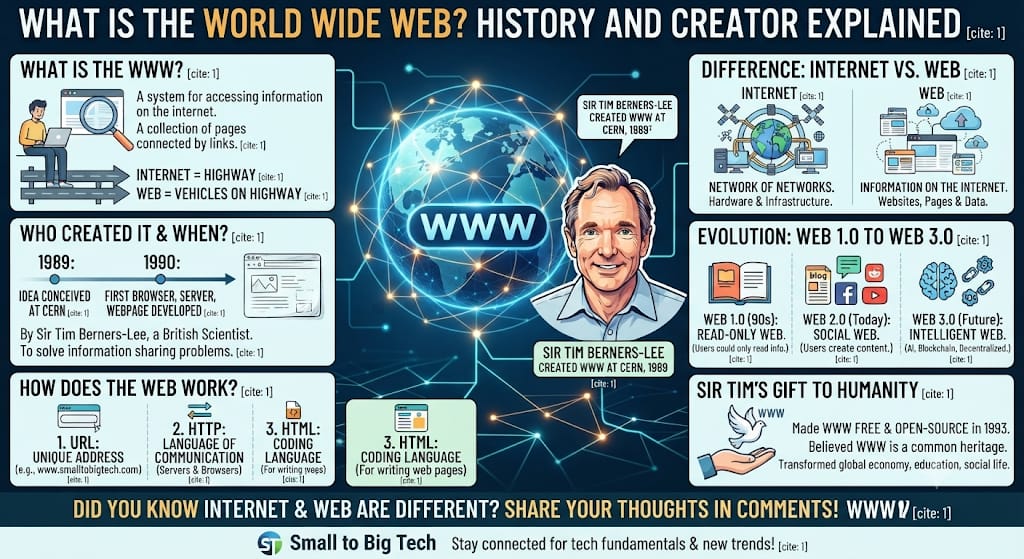
The World Wide Web, abbreviated as WWW or simply “the Web,” is essentially a system for accessing information on the internet. If the internet is a vast highway, the web is the traffic or vehicles traveling on that road. It is a global collection of pages connected through hypertext links, which we view using a web browser.
Who created it and when?
The World Wide Web was invented by a British computer scientist named Sir Tim Berners-Lee. He accomplished this feat in 1989 while working at the famous research institute CERN in Switzerland.
Tim Berners-Lee came up with this idea because he and his fellow scientists were facing severe difficulty in sharing information with one another. He wanted to find a way for information to be transferred automatically from one place to another. By the end of 1990, he had developed the world’s first web browser, the first web server, and the first web page.
How does the Web work?
The entire system of the World Wide Web stands on a few fundamental pillars:
- URL (Uniform Resource Locator): This is the unique address of every web page (such as www.smalltobigtech.com).
- HTTP (Hypertext Transfer Protocol): This is the language through which web servers and browsers communicate.
- HTML (Hypertext Markup Language): This is the coding language in which web pages are written.
The difference between the Internet and the Web
It is very important to understand what the internet is versus what the web is:
- Internet: This is a network of computers and servers spread across the world, connected through cables and satellites.
- Web: This is the information (websites and data) that exists on this internet network.
The evolution of the Web: From Web 1.0 to Web 3.0
The journey of the World Wide Web is a story of continuous evolution:
- Web 1.0: This was the era of the 90s where we could only read information. It was a “Read-Only” web.
- Web 2.0: This is today’s era, known as the “Social Web.” Here, the user creates content themselves (Facebook, YouTube, blogs). It is a “Read-Write” web.
- Web 3.0: This is the future concept based on Artificial Intelligence (AI) and blockchain. It will be a more intelligent, secure, and decentralized web.
Sir Tim Berners-Lee’s gift to humanity
If Tim Berners-Lee had wanted, he could have patented this invention and become the richest person in the world, but he made it free and open-source for the entire world in 1993. He believed that the web is a common heritage of humanity, which should not be controlled by any single company. Today, our economy, education, and social interactions have progressed so much thanks to that single decision.
Conclusion
The World Wide Web is not just a complication of computers; it is a means of gathering human knowledge in one place. The seed that Tim Berners-Lee planted in 1989 has now become a sturdy tree under whose shade the entire world has gathered. At “Small to Big Tech,” our commitment is to keep you informed about these fundamental stories of technology that are shaping our today.
Did you know that the internet and the web are two different things? What are your thoughts on this great gift from Sir Tim Berners-Lee? Do let us know in the comments!
Stay connected with “Small to Big Tech” for fundamental technology information and new trends!