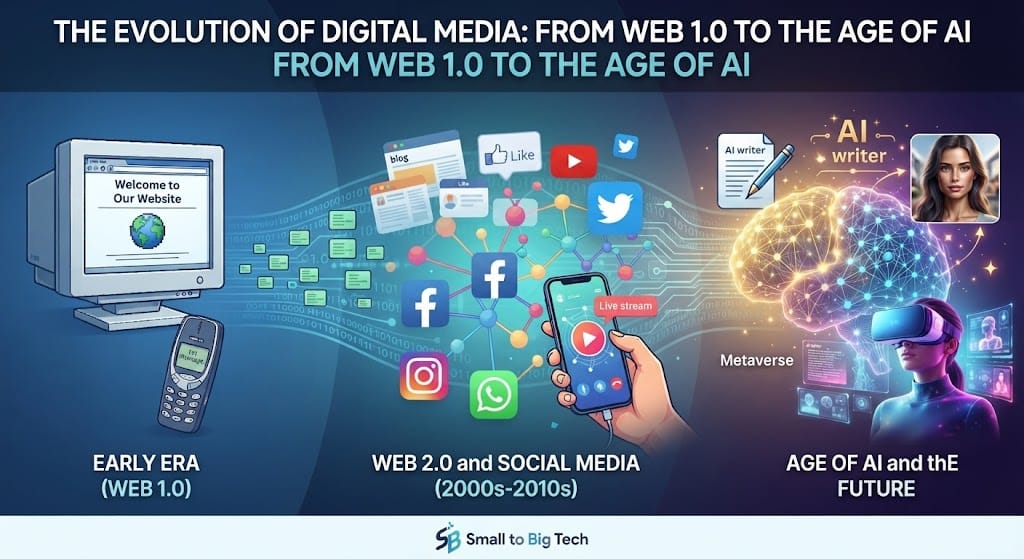
Throughout human history, means of communication have always played a key role in shaping society. From carvings on stones to today’s social media era, we have traveled a long way. “Digital media” is essentially the most modern and fastest milestone of this journey. In today’s post, we will review the evolution of digital media and try to understand how it has turned the world into a global village.
What is Digital Media?
Digital media refers to all communication channels that create, transmit, and store information in a digital format. This includes websites, social media, online news, digital audio, video, and mobile applications. Unlike traditional media (newspapers, TV, radio), it enables direct interaction between the user and the media.
Key stages of evolution
1. Early Era: The Establishment of Websites (1990s)
The formal beginning of digital media took place in the 90s when the internet became accessible to the general public. At that time, media meant only static websites. Newspapers started their online editions, but they were just digital versions of the newspaper with no significant change or user participation involved.
2. The Web 2.0 Revolution (2000s)
This was the era that changed the definition of digital media. With the arrival of blogs, forums, and social networking sites (like MySpace and early Facebook), the user became not just a reader of information, but a creator of it. The establishment of YouTube brought video media to the masses.
3. The Dominance of Social Media and Mobile (2010 to present)
Smartphones and high-speed internet moved digital media into our pockets. The era of waiting for information is over; now, every person is a reporter. Facebook, Instagram, WhatsApp, and Twitter (X) have reduced the speed of news to seconds. Live streaming and short-video formats (like TikTok) have completely changed the way media is consumed.
Impacts of Digital Media
- Democracy and Voice: Now, every common man does not need to depend on a large media house to convey their message.
- Business Changes: Digital marketing has replaced traditional advertising. Companies can now show their users advertisements according to their preferences.
- Access to Education: Online courses and digital libraries have opened the world of knowledge to everyone.
The Future of Digital Media: Artificial Intelligence (AI)
The future of digital media is now in the hands of “Artificial Intelligence.” AI now has the ability to write news, create images, and edit videos. In the future, we will observe media that will be personalized according to each user’s needs. Furthermore, concepts like the Metaverse are leading us toward a digital media where we will not just see information, but also feel it.
Challenges of Digital Media
While digital media has created conveniences, it also has some dark aspects:
- Fake News: The spread of misinformation has become a global problem.
- Digital Privacy: Our data is being tracked constantly, which creates security issues.
- Information Overload: Excessive information has affected human concentration spans.
Conclusion
The evolution of digital media is not just a technical advancement; it is a new formation of human society. We have created a world where distances have vanished and the speed of thoughts is equal to the speed of light. On this platform of “Small to Big Tech,” our goal is to keep you informed about the technical nuances of this changing world. Digital media is a powerful tool; its correct and responsible use is what can secure our future.
What, in your opinion, is the most positive change digital media has brought into our lives? Do you think traditional media will now disappear? Do share your thoughts in the comments!
Stay connected with “Small to Big Tech” for more interesting evolutionary journeys in the digital world and technology news!