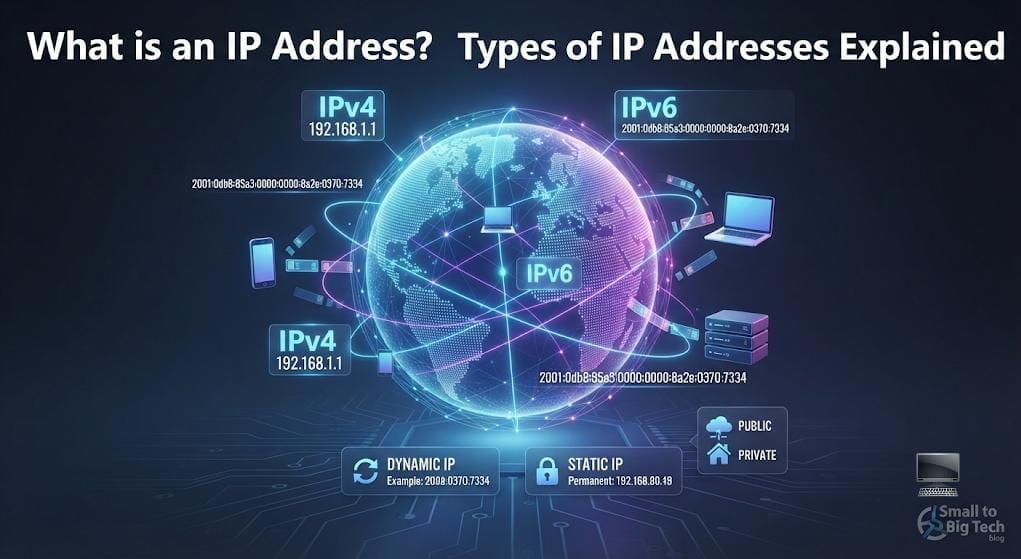
In today’s modern digital world, all of us use the internet, visit various websites, send messages to one another, and enjoy online videos. But have you ever deeply considered why, when you send a message or request from your mobile or computer to a server located anywhere in the world, that data always returns precisely to your own device? Behind this entire miracle operates an extremely vital digital system known as an IP address.
If you belong to the world of technology blogging, networking, or computer science, thoroughly understanding the basic concept of an IP address and all its types is essential for you. Today, on this platform of “Small to Big Tech,” we will discuss this topic in extreme detail so that you can understand how the identification system of every computer or mobile works in this vast world of the internet.
Definition and Core Concept of an IP Address
The full form of IP is Internet Protocol, and address means a location. Therefore, in extremely simple terms, an IP address is a numerical address in the digital world assigned to every device connected to the internet or any local network.
Just as a postman uses your physical home address to deliver a letter or parcel, this digital address is similarly required to deliver data or information to your computer on the internet. If these digital addresses did not exist, the exchange of data on the internet would be utterly impossible.
How Does an IP Address Work?
Whenever you type a website name into your browser, your computer does not understand that name directly. In the internet world, every website actually exists on a server’s IP address.
Your computer first uses the Domain Name System (DNS) to translate that name into an IP address, and then sends its request to that digital address. The server sees this address and routes the data back to your exact IP address. This entire process is completed in a fraction of a second without us even realizing it.
The Basic Generations of IP Addresses (IPv4 vs. IPv6)
With the advancement of technology and the passage of time, two major generations or versions of IP addresses have been introduced and are in use today:
1. IPv4
This is the earliest and still the most widely used version on the internet. It consists of four chains of numbers separated by dots.
- Limitations and Problem: This system is based on 32 bits, meaning it can generate a total of approximately 4.3 billion unique addresses. When this system was created, this number seemed massive, but in today’s era—when billions of people are using billions of smartphones, laptops, and smart devices—these addresses are beginning to fall short.
2. IPv6
To address the risk of IPv4 addresses running out, engineers introduced a new and highly advanced system given this name. It consists of hexadecimal numbers.
- Benefit: This is a 128-bit based system, providing so many billions and trillions of addresses that for many centuries to come, no device on earth will ever run out of an IP address. Even if devices were connected equivalent to every single grain of sand on Earth, its addresses still would not run out.
Types of IP Addresses Based on Usage and Networking
Depending on the nature of your network or usage, IP addresses are further divided into two main categories:
1. Dynamic IP Address
This is an IP address that is not permanent; whenever you restart your router or reconnect to the internet, your internet service provider assigns you a new IP address. It is typically used for homes and the mobile phones and laptops of everyday users.
2. Static IP Address
This is an IP address that remains permanently the same and never changes. Whether you turn off the internet or restart the router, the exact same old address is maintained. This is used for servers of large websites and business organizations that require continuous remote access on a single address.
Difference Between Public IP Address and Private IP Address
- Private IP Address: This is the internal address assigned to all devices inside your home by your home Wi-Fi or router. It is used exclusively within your home’s local network.
- Public IP Address: This is the actual address assigned to your router by your internet service provider through which the entire world views your network on the internet.
Conclusion
The IP address essentially holds the status of the internet’s soul, without which any kind of communication or data exchange in this digital world is unimaginable. From a small digital tablet to the largest servers in the world, everything is connected under this system. Our goal at “Small to Big Tech” has always been to provide you with honest and accurate technical information so that your hard-earned money and time are utilized correctly.
Do you know what the public IP address of your own internet connection is right now? You can easily check it by searching online on Google. Let us know in the comments!
Stay connected with “Small to Big Tech” for the latest information from the world of technology, digital tools, and the best guides!