In our daily lives, we use a tiny piece of plastic or a digital chip inside our smartphones known as a SIM card. Without this small card, the concept of a mobile phone is unimaginable in today’s era. This little card connects us with people all around the world, provides internet access, and identifies our mobile number.
If you belong to the world of technology blogging, telecommunications, or mobile history, deeply understanding the fascinating origin of the SIM card and its various types will be extremely important for you. Today, on this platform of “Small to Big Tech,” we will discuss this topic in detail so you can learn how this tiny chip was invented and what amazing changes it has undergone over time.
What is a SIM Card and How Does It Work?
The acronym SIM stands for Subscriber Identity Module. It is a small integrated circuit or microchip that stores the personal identity, network information, security keys, and a few phonebook numbers of a mobile network operator’s customer.
When you dial a call on your phone or use the internet, the SIM card sends an authenticated signal of your identity to the network tower, after which your connection is established.
The Historical Origin of the SIM Card
The tiny nano SIM or digital eSIM we use today did not start out so small. Let’s look at how it all began:
1. Year of Invention and First Model (1991)
The first SIM card was created in 1991 by Giesecke & Devrient, a smart card manufacturing company based in Munich, Germany. They sold this chip to an accredited Finnish mobile network operator.
2. Credit Card-Sized First SIM Cards
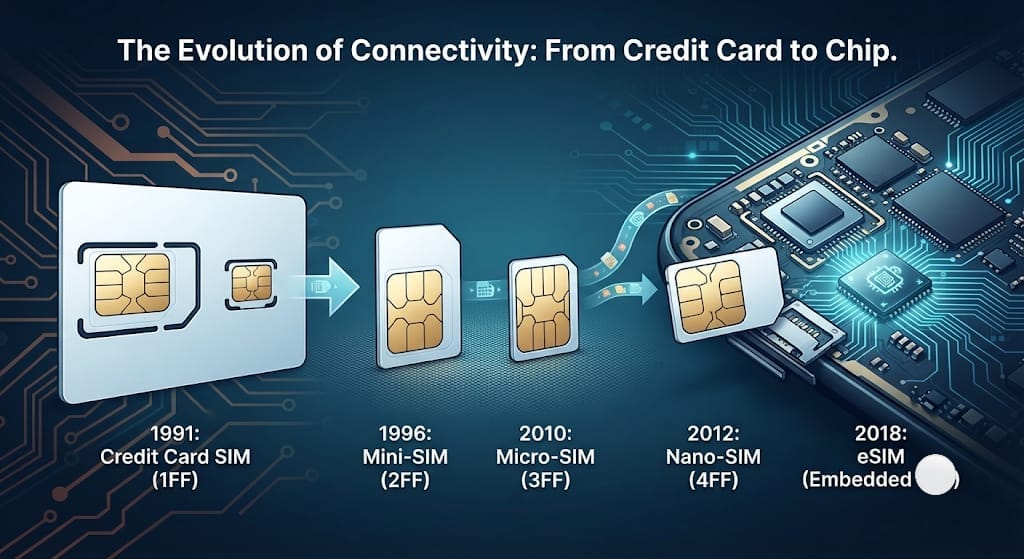
Unlike today’s era, the SIM cards manufactured initially were as large as a modern credit card or ATM card. This entire card was inserted into a large slot on the back of the mobile phone. As technology progressed, mobile phones became smaller and slimmer, creating a need to downsize the SIM card as well.
Various Types and Evolution of the SIM Card
In response to changing mobile phone designs over time, several major changes occurred in the size and technology of SIM cards, detailed as follows:
1. Full-Size SIM
This was the very first SIM card, identical in size to a credit card. It was inserted into older, bulky mobile phones used in the early 1990s.
2. Mini SIM
When mobile phones became slightly smaller, the mini SIM was introduced in 1996. This is the traditional SIM card that almost all of us have seen and used the most in our lives. It features a small, square plastic frame around it.
3. Micro SIM
Following the dawn of smartphones after 2003, when internal hardware required more space inside mobile phones, Apple introduced the micro SIM in 2010 with the iPhone 4. Its size was considerably smaller than the mini SIM, making room inside the phone for the battery and other components.
4. Nano SIM
This is the most widely used physical SIM in today’s era, first introduced in 2012. Its size is about forty percent smaller than the micro SIM, with virtually no plastic border left—only the inner golden chip remains.
5. eSIM
This is the most advanced revolution in the world of telecommunications. An eSIM is not a piece of plastic; rather, it is a digital chip fixed directly inside the phone’s motherboard.
- How does it work? You do not need to buy a plastic SIM from a shop. Your mobile network operator gives you a QR code, and upon scanning it, your number is activated digitally inside your phone. You can store multiple eSIMs simultaneously in a single phone.
Physical SIM Card vs. Modern eSIM
- Traditional Physical SIM: Requires a tray to insert and remove from the phone; if the phone is lost or damaged, the SIM must also be replaced; and it can be ruined by water or dust.
- Modern eSIM: Secured inside the phone so no one can steal it, remains safe from water and dust, and provides the freedom to use multiple networks at the same time.
Conclusion
Beginning from the size of a credit card, the journey of the SIM card has now reached an invisible digital code embedded right inside the phone: the eSIM. This tiny invention has forever transformed the communication system worldwide. Our goal at “Small to Big Tech” has always been to provide you with honest and accurate technical information so that your hard-earned money and time are used correctly.
Have you started using an eSIM in your smartphone yet, or do you prefer the traditional nano SIM? Let us know in the comments!
Stay connected with “Small to Big Tech” for the latest information from the world of technology, digital tools, and the best guides!