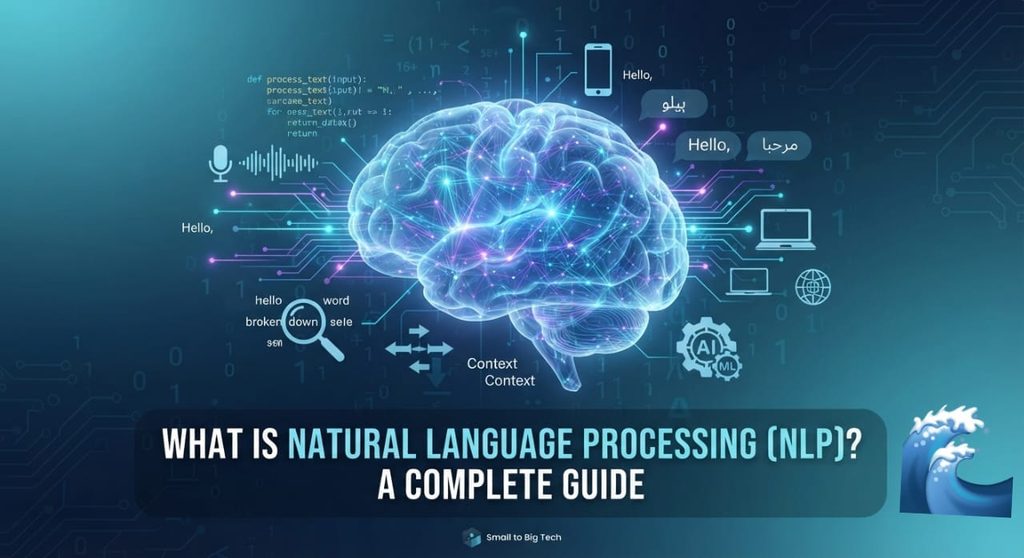
In today’s modern digital and technological world, all of us use smartphones, voice assistants, Google Search, and chatbots on a daily basis. When you speak to ask a question from your mobile or computer, or get text in another language translated into your own language in seconds, have you ever wondered how these machines understand our language so beautifully? Behind this entire miracle operates a vital branch of computer science and artificial intelligence known as Natural Language Processing, or NLP.
If you belong to the world of technology blogging, artificial intelligence, or computer science, thoroughly understanding this foundational concept of NLP and its working methods is essential for you. Today, on this platform of “Small to Big Tech,” we will discuss this topic in extreme detail so that you can understand how machines comprehend spoken and written human language.
What is Natural Language Processing (NLP)?
Natural Language Processing is a branch of artificial intelligence and computer science that enables communication between computers and humans. In simple terms, it empowers computers to read, listen to, analyze, and comprehend human language (whether it is Urdu, English, Arabic, or any other language).
Traditionally, computers only understand zeros and ones (0 and 1) in binary language or strict coding. But humans have always spoken in natural languages that are complex, bound by grammar rules, and sometimes ambiguous. NLP technology transforms these complex human languages into digital data, making them understandable for computers.
How Does NLP Work?
The process of Natural Language Processing goes through highly complex stages. When a human provides text or voice input to a computer, the system processes it under the following key steps:
1. Linguistic Analysis and Data Cleaning
First, the computer breaks down human language sentences into smaller parts. It closely examines word spelling, grammatical accuracy, and sentence structure so the machine can grasp the original meaning.
2. Meaningful Combination and Contextual Understanding
In human language, a single word can have multiple meanings depending on the situation or context. Modern NLP algorithms determine the actual intent of a word used within a sentence.
3. The Role of Machine Learning and Deep Learning
Today’s NLP systems do not rely merely on old rules; instead, they learn automatically with the help of machine learning and deep learning. The more data these systems consume, the better their ability to understand and speak language becomes.
Amazing Uses of NLP in Daily Life
We use NLP technology countless times knowingly or unknowingly in our daily lives, a few important examples being:
1. Voice Assistants
Voice assistants present in modern smartphones and home devices, such as Google Assistant, Apple’s Siri, and Alexa, listen to our spoken words, understand them with the help of NLP, and then execute our commands.
2. Automated Translation Systems
Google Translate or other translation tools that convert text from one language to another in minutes or seconds are all feats of this technology. They do not just perform word-for-word translation; rather, they consider the meaning of the entire phrase.
3. Chatbots and Customer Support
Large companies host automated chatbots on their websites that answer customer inquiries just like a human. They read user language to find immediate solutions to their problems.
Traditional Computer Program vs. NLP System
- Traditional Computer Program: Operates solely on predefined instructions and code; it cannot understand human emotions, tones, or ambiguous sentences at all.
- NLP System: Equipped with artificial intelligence capable of understanding the fluctuations of human language, various accents, grammatical nuances, and even the emotions hidden within sentences.
Conclusion
Natural Language Processing is essentially the biggest medium for bridging the gap between humans and technology. Thanks to this technology, machines today are no longer just bound to our commands, but have become capable of conversing with us and solving our problems. Our goal at “Small to Big Tech” has always been to provide you with honest and accurate technical information so that your hard-earned money and time are used correctly.
Have you ever noticed how many times a day you use NLP technology on your phone? Let us know in the comments!
Stay connected with “Small to Big Tech” for the latest information from the world of technology, digital tools, and the best guides!