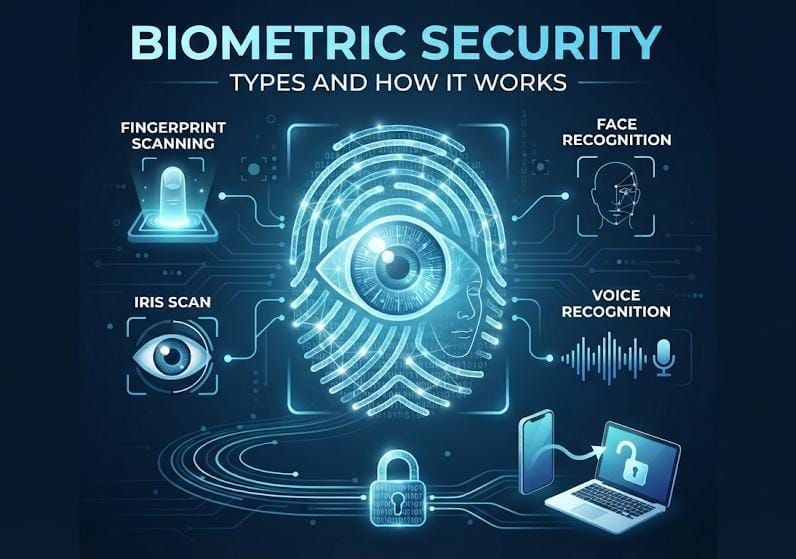
In today’s modern digital and technological world, all of us use our thumbprints, faces, or retinas to lock our smartphones, access our bank accounts, and mark attendance at offices. In olden times, locks and keys were used to keep oneself secure, or passwords and PIN codes had to be remembered, but the risk of passwords being forgotten or stolen always existed. A highly secure and advanced solution to all these security issues, which is being adopted worldwide today, is known as biometric security.
If you belong to the world of technology blogging, security systems, or computer science, thoroughly understanding this foundational concept of biometric security and its working methods is essential for you. Today, on this platform of “Small to Big Tech,” we will discuss this topic in extreme detail so that you can understand how this technology transforms human physical characteristics into the most secure password.
What is Biometric Security?
Biometric security is an automated system that verifies a person’s identity based on their unique physical or behavioral characteristics. The word “biometrics” is made up of two parts, where “bio” means life or body, and “metrics” means measurement.
In traditional methods, you have to remember something (like a password) or keep something with you (like a key or a card), but in biometric security, your own self becomes your identity and your key. Since no two humans in the world have identical thumbprints, facial features, or iris patterns, this system is considered extremely secure.
How Does Biometric Security Work?
The entire process of a biometric system is based on advanced computer science and security algorithms. Whenever a new user registers in this system, the following steps are taken:
1. Data Enrollment and Scanning
First, with the help of a biometric scanner (such as a fingerprint reader or face camera), a digital image or pattern of the user’s physical part is captured. This scanner records the finest lines or features of the body.
2. Conversion into a Digital Code
After scanning, computer software converts these physical features into a special mathematical formula and digital code. This process is called template creation. The original image or mark is not stored in the system; only its encrypted code is saved.
3. Identity Verification
Whenever that user attempts to unlock the system again, the system takes a new scan and compares it with the old stored code. If both codes match completely or within the required threshold, access is granted; otherwise, the door or device remains locked.
Most Important Types of Biometric Security
With the advancement of technology, several types of biometric security have been introduced, the important ones being:
1. Fingerprint Scanning
This is the oldest and most widely used type of biometrics. The patterns formed on the tips of every human’s thumbs and fingers are unique. This is most commonly found in smartphones and office biometric attendance machines.
2. Face Recognition
In this technology, a camera closely examines your facial features, the distance between your eyes, and the structure of your nose and jaw. It is now frequently used for security in modern smartphones and airports.
3. Iris Scan
This scans the complex patterns formed around the colored part of the eye, known as the iris. This method is counted among the most secure ways in the world because the lines of the eye’s iris never change.
4. Voice Recognition
In this system, the fluctuations, speaking style, and frequency of a human’s voice are recorded. Its use is increasing in banking call centers and smart home systems.
Password Security vs. Biometric Security
- Traditional Password: Passwords must be remembered, people often choose easy passwords that can be hacked, and if a password is stolen, anyone else can gain access.
- Biometric Security: No need to memorize anything here; physical characteristics are extremely difficult to steal or copy, and it is vastly faster and more reliable in terms of security.
Conclusion
Biometric security has completely changed the standard of protection in our digital and physical lives. From the hassle of forgotten passwords to the risks of hacking, this technology has presented a sustainable solution to every difficulty. Our goal at “Small to Big Tech” has always been to provide you with honest and accurate technical information so that your hard-earned money and time are utilized correctly.
Do you prefer biometric security over passwords in your daily use? Let us know in the comments!
Stay connected with “Small to Big Tech” for the latest information from the world of technology, digital tools, and the best guides!