In today’s modern digital and online world, every business, organization, and individual is reaching people worldwide through their website. Whether you belong to an e-commerce store, a news blog, or a corporate company, a website is the biggest identity of your digital presence. But as internet usage increases, the risks of cybercrimes, hacking, and data theft have also increased to a dangerous extent. If your website is not secure, any attacker can hack it, steal your valuable data, or harm your users.
If you belong to the world of technology blogging, web development, or online business, deeply understanding this foundational concept of website security and all its protection methods is essential for you. Today, on this platform of “Small to Big Tech,” we will discuss this topic in extreme detail so that you can learn how to keep your website safe from hackers and cyber attacks.
What is Website Security?
Website security refers to all the steps, technical measures, and software protection tools that safeguard any website from unauthorized access, hacking, virus attacks, and data theft risks. Its primary objective is to make the website’s server, its database, and users’ personal information completely secure.
When a website is launched on the internet, it becomes a target for hackers and automated bots from all over the world. These bots try to take over the website by taking advantage of weak passwords or outdated scripts. A strong security system ensures that no irrelevant person or program can gain access to your website’s back end.
Most Significant Security Threats Facing Websites
To attack any website, hackers use various methods, among which the major threats are:
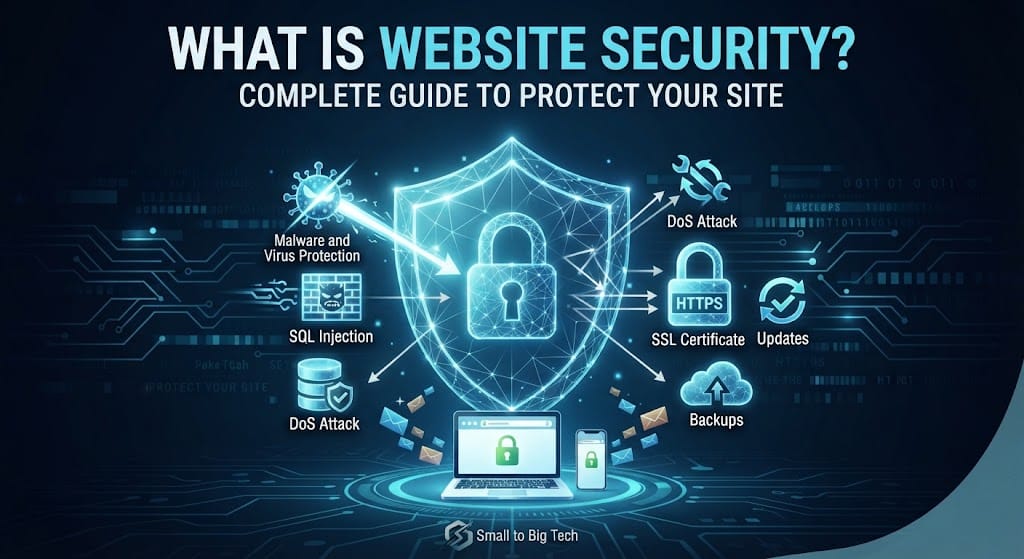
1. Malware and Virus Attacks
Malware are harmful softwares hidden by hackers within website files. These viruses can not only destroy the website but also infect the computers of users visiting it.
2. SQL Injection Attacks
In this method, hackers enter malicious codes into the database through a website’s login form or search bar so they can steal confidential information, passwords, and user data.
3. Denial of Service (DoS) Attacks
In this attack, hackers send millions of fake traffic requests or queries to a website simultaneously, causing the server to crash and the website to stop working for genuine users.
Effective and Practical Methods to Secure a Website
To protect your website from hackers and provide it with foolproof security, you should take the following important steps:
1. Use an SSL Certificate
Having an SSL certificate is the first and most basic requirement for every website. When HTTPS is active on your website, all data traveling between the server and the browser is encrypted, preventing anyone from stealing data in transit.
2. Strong Passwords and Two-Factor Authentication
Always use long and complex passwords for the website’s admin panel, hosting account, and cPanel. Additionally, make sure to enable Two-Factor Authentication (2FA) so that even if someone discovers the password, they cannot log in without the second step.
3. Regular Updates for Software, Plugins, and Themes
Most hackers exploit vulnerabilities present in old and unupdated plugins or WordPress versions. Always keep all your website’s systems updated to the latest versions.
4. Taking Regular Backups
The best way to protect against any emergency or hacking attack is to regularly back up your entire website data and store it in a secure location. This way, if any glitch occurs, you can restore all data within minutes.
Traditional Insecure Website vs. Secure Website
- Insecure Website: Lacks an SSL certificate, uses weak passwords, has outdated plugins, and faces a constant threat of being hacked.
- Secure Website: Features HTTPS protection, is equipped with a firewall, has regular backups taken, and keeps user data completely safe.
Conclusion
Website security is the fundamental guarantee of success for any online business or blog. If you want to win the trust of your readers and protect your hard work from going to waste, never compromise on security matters. Our goal at “Small to Big Tech” has always been to provide you with honest and accurate technical information so that your hard-earned money and time are used correctly.
What steps have you taken so far to improve your website’s security? Let us know in the comments!
Stay connected with “Small to Big Tech” for the latest information from the world of technology, digital tools, and the best guides!