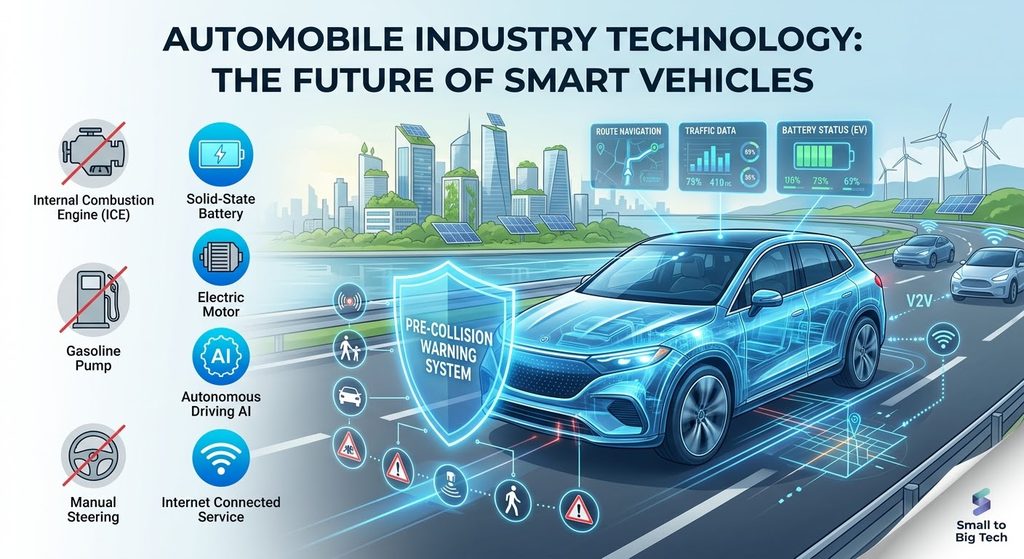
In today’s modern and fast-paced world, technology has refined every sphere of human life, but the sector witnessing the most surprising and revolutionary changes is the automobile industry. There was a time when the purpose of a car was merely to travel from one place to another, while relying entirely on mechanical parts, petrol or diesel engines, and the driver’s skills. However, today’s modern vehicles are no longer just mechanical transports; they have become supercomputers on wheels. From electric vehicles to driverless automated systems, the automotive world has entered a brand-new era.
If you belong to the world of technology blogging, modern mobility, or engineering, deeply understanding this advanced automotive industry technology is essential for you. Today, on this platform of “Small to Big Tech,” we will discuss this topic in extreme detail so you can learn how modern smart features and artificial intelligence have made vehicle travel safer, easier, and more eco-friendly.
What is Automobile Industry Technology?
Automobile industry technology refers to all the advanced engineering, computer systems, artificial intelligence, software, and sensors used in the design, manufacturing, and operation of modern vehicles. The primary goal of this technology is to make human life safer during travel, reduce fuel wastage, and keep the environment pollution-free.
In the past, a vehicle’s performance was judged by its engine size and horsepower, but today, a vehicle’s standard is determined by how smart its software is, what sensors are installed, and how active a role it plays in protecting the driver from accidents.
Major Revolutions in the Automobile Industry
The key technologies that have played the most significant roles in transforming the automotive world are detailed as follows:
1. Electric Vehicles and Battery Technology
The days of traditional petrol and diesel vehicles are rapidly drawing to a close. Electric vehicles not only emit no smoke, but also protect the environment from pollution. Modern lithium-ion and solid-state batteries have extended vehicle ranges to several hundred kilometers, making long-distance travel extremely economical and eco-friendly.
2. Autonomous and Driverless Vehicles
Thanks to artificial intelligence and the Internet of Things, vehicles are now being introduced that can drive on the road automatically without driver intervention. These vehicles use cameras, radar, and sensors to evaluate the surrounding environment, applying automatic brakes in time upon detecting traffic signals, pedestrians, and other vehicles.
3. Internet Connectivity in Vehicles
Modern vehicles are now connected to the internet at all times. With this, the driver receives real-time road traffic conditions, route navigation, and weather updates. If a technical fault occurs in any part of the vehicle, the system automatically issues an alert and sends an automated message to a nearby workshop or emergency response teams in critical situations.
Outstanding Benefits of Modern Automobile Technology
This modern technology has brought about the following revolutionary changes and benefits in human travel:
1. Significant Reduction in Road Accidents
Humans can make mistakes during travel, such as falling asleep, using a mobile phone, or speeding, but automated security systems and pre-collision warning sensors have dramatically reduced the rate of road accidents.
2. Elimination of Pollution and Environmental Protection
Exhaust fumes from traditional fuels pollute our atmosphere and contribute to global warming. The adoption of electric and hybrid vehicles has significantly reduced carbon emissions, helping keep the environment clean.
3. Savings in Travel Costs
Although buying modern and electric vehicles seems slightly expensive at first, over time, drivers are saved from heavy petrol costs and frequent mechanical maintenance, resulting in substantial savings.
Traditional Vehicles vs. Modern Smart Vehicles
- Traditional Vehicles: Run on petrol or diesel, rely entirely on driver control, consume more fuel recklessly, and feature extremely limited security measures.
- Modern Smart Vehicles: Run on electricity or hybrid systems, come equipped with automated sensors and artificial intelligence, are eco-friendly, and make travel safe and reliable.
Conclusion
Automobile industry technology has not only changed the way we travel, but has also opened a completely new chapter in the future of mobility. In the coming years, we will see vehicles becoming even smarter, faster, and safer, transforming the global transportation system forever. Our goal at “Small to Big Tech” has always been to provide you with honest and accurate technical information so that your hard-earned money and time are utilized correctly.
Do you think electric and autonomous vehicles will completely replace traditional petrol cars in the next few years? Let us know in the comments!
Stay connected with “Small to Big Tech” for the latest information from the world of technology, digital tools, and the best guides!