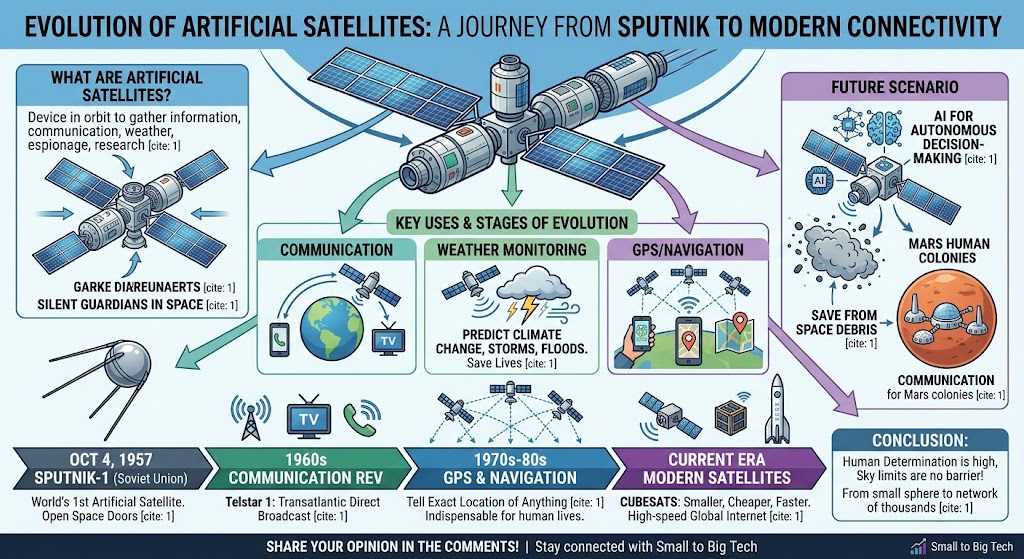
If any one technology has transformed our world into a “global village” in human history, it is artificial satellites. Today, we can talk to anyone in any corner of the world on our mobile phones, know the weather forecast, and travel on unknown paths with the help of GPS; all of this has been made possible thanks to artificial satellites. In today’s post, we will learn how these silent guardians in space came into existence and where they stand today.
What are artificial satellites?
An artificial satellite is a device that humans send into Earth’s orbit to gather various information. These satellites revolve around the Earth and perform important tasks such as communication, espionage, scientific research, and monitoring the Earth.
The first step in history: Sputnik-1
The journey of artificial satellites began on October 4, 1957, when the Soviet Union sent the world’s first artificial satellite, “Sputnik-1,” into space. It was merely a metal sphere a little over a foot in diameter with four antennas. Its success surprised the entire world and opened the doors of space for humanity. After this, America also sent its first satellite, “Explorer-1,” into space.
Key stages of evolution
1. Communication Revolution
After the 1960s, the biggest use of artificial satellites became spreading television and telephone signals across the globe. Satellites like “Telstar 1” made direct broadcasts across the Atlantic Ocean possible for the first time.
2. Weather Monitoring
These satellites revolutionized the prediction of climate change, storms, and floods. Now, it has become possible to warn humans before any natural disaster, saving precious lives.
3. GPS and Navigation
In the 1970s and 80s, the GPS system was launched. These satellites became capable of telling the exact location of anything on Earth. Today, GPS has become an indispensable part of our lives.
Modern era: Smaller, cheaper, and faster
The current era is that of CubeSats and small satellites. In the past, artificial satellites were the size of a car, but now, thanks to technology, they have shrunk to the size of a shoebox. Private companies like SpaceX are sending thousands of satellites into space to provide high-speed internet to the whole world.
Future scenario
Future satellites will be even smarter. With the help of Artificial Intelligence (AI), these satellites will autonomously determine their paths and will also have the ability to save themselves from space debris. Furthermore, these satellites will also provide communication networks for human colonies on other planets, such as Mars.
Conclusion
This journey of artificial satellites is not just a technical achievement but the pinnacle of human quest. In the journey of “Small to Big Tech,” this technology holds the status of a milestone. From where we started to where we have reached—from a small metal sphere to a network of thousands of satellites. This proves that if human determination is high, even the limits of the sky do not become a barrier.
Did you know how your mobile’s GPS works? Are you excited about the future of space internet? Do share your opinion in the comments.
Stay connected with “Small to Big Tech” for more information regarding the history and evolution of technology.