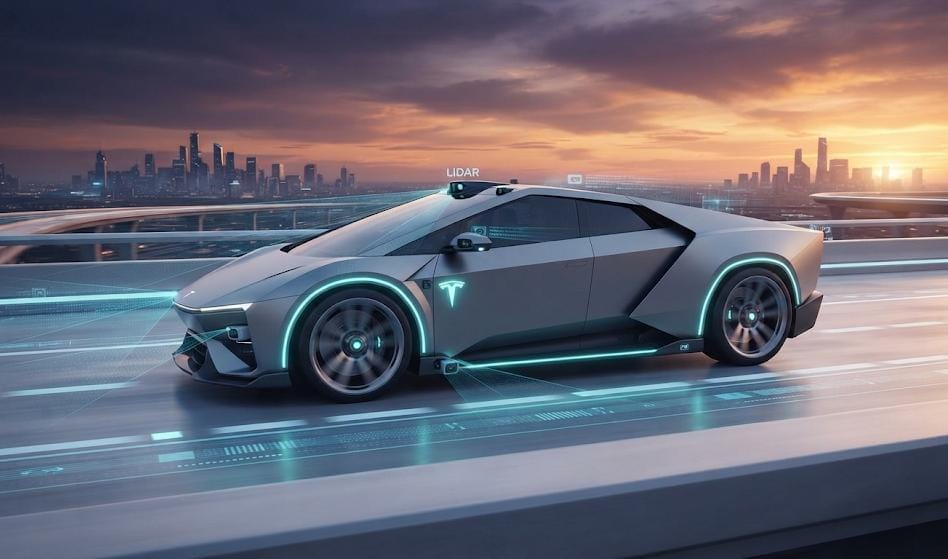
Whenever self-driving cars are mentioned in the world of modern technology, the very first name that comes to mind is Tesla. Elon Musk’s company has revolutionized the car manufacturing industry through its Autopilot and Full Self-Driving technology. Now the question arises: how does this system work with such sophistication and precision that it amazes even the driver sitting in the driver’s seat?
If you belong to the world of technology blogging, car enthusiasm, or digital innovation, understanding the inner story of Tesla’s Autopilot will be extremely fascinating for you. Today, on this platform of “Small to Big Tech,” we will discuss this topic in detail so that you can know how this modern system works its magic on the road.
What is the Autopilot System?
Autopilot is essentially an advanced driver assistance system provided in Tesla cars. It functions similarly to an airplane’s autopilot, where the car can automatically stay in its lane, control its speed, apply brakes based on the vehicle ahead, and navigate highway curves without any human intervention.
However, it is very important to remember that standard Autopilot is not fully autonomous; rather, it requires the driver to remain alert at all times and keep their hands on the steering wheel.
Core Components and Technology of Tesla Autopilot
Tesla’s system does not rely on a single technology; instead, it is a brilliant combination of hardware and software. Older generations of autonomous cars heavily used lidar and radar sensors, but Tesla chose a unique path:
1. Powerful Cameras
Tesla removed traditional expensive radar and lidar sensors from its vehicles and relied entirely on cameras. A total of eight cameras are installed around the car, providing a 360-degree field of view. These cameras observe road markings, other vehicles, pedestrians, traffic signals, and hazards with extreme precision.
2. Neural Networks and Artificial Intelligence
Gigabytes of data streaming from the cameras are fed into Tesla’s powerful on-board computer. Here, artificial intelligence and neural networks analyze this data in milliseconds. This system works just like the human brain, deciding in real-time whether to slow down the vehicle or apply the brakes.
3. Ultrasonic Sensors and Data Processing
Small sensors surrounding the vehicle help measure the distance to nearby obstacles, walls, or other cars, which is especially crucial during parking or low-speed driving.
How Does Autopilot Work? (Step-by-Step Procedure)
When you activate Autopilot or Full Self-Driving (FSD) in a Tesla, the car drives automatically through the following steps:
- Environmental Perception: All eight cameras work together to build a 3D map of the surrounding environment. This identifies every moving object (such as a motorcycle, pedestrian, or dog) and stationary object (such as roadside signboards).
- Planning and Decision Making: The computer decides which direction the car should move, what speed to maintain, and what distance to keep from the vehicle ahead. This entire process happens so fast that decisions are made before a human can blink.
- Execution: Upon the computer’s command, the car’s steering, accelerator, and brakes operate automatically, allowing the vehicle to change direction or stop smoothly without any jerks.
Tesla Vision and the Journey Toward the Future
In the beginning, Tesla vehicles used radar, but Elon Musk and his engineering team proved that just as humans drive using only two eyes (cameras) and a brain, a camera-based “Tesla Vision” can be even more effective. Today, Tesla’s system gathers millions of kilometers of driving data from all over the world and uses cloud-based supercomputers to make its artificial intelligence model smarter day by day.
Traditional Driving vs. Tesla Autopilot
- Traditional Driving: Constant fatigue is common for drivers, especially during long journeys or traffic jams, as feet must constantly remain on the brake and accelerator.
- Tesla Autopilot: It reduces driver fatigue during long trips and lowers accident risks because cars can apply emergency brakes much faster than humans.
Conclusion
Tesla’s Autopilot system is not just a fancy feature, but a massive step toward the future of transportation. Although this technology is not yet one hundred percent autonomous and still requires human supervision, its performance has amazed the entire world. Our goal at “Small to Big Tech” has always been to provide you with honest and accurate technical information so that your hard-earned money and time are utilized correctly.
Have you ever traveled in a Tesla car, or what are your thoughts on these self-driving systems? Let us know in the comments!
Stay connected with “Small to Big Tech” for the latest information from the world of technology, digital tools, and the best guides!