Throughout human history, technology has played a crucial role in bridging distances. If we talk about travel, after airplanes, the technology that has brought the biggest revolution is “high-speed trains.” There was a time when steam engines took hours to cover miles, but today’s modern trains are nearing the speed of sound. In today’s post, we will take a detailed look at the evolution and technology of high-speed trains.
What is a high-speed train?
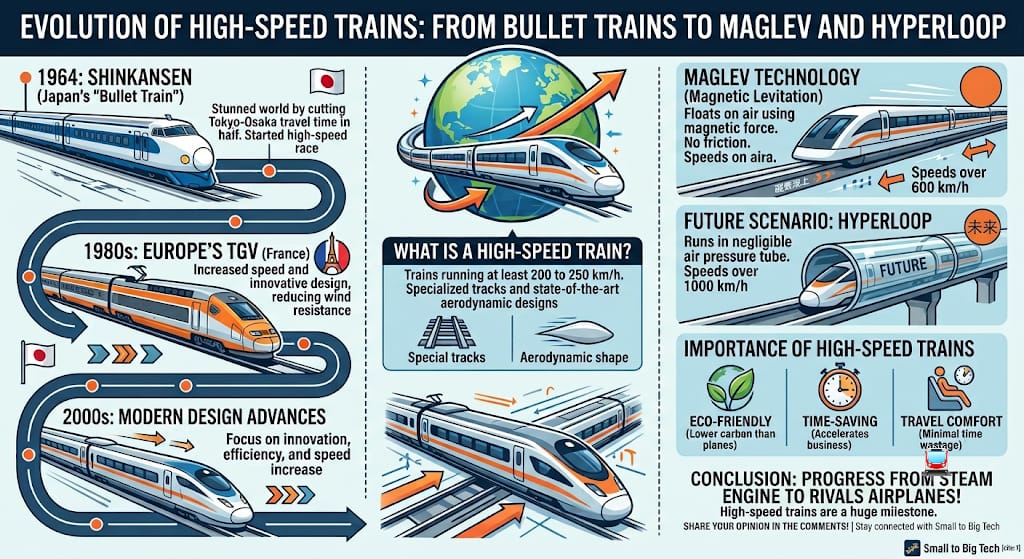
Generally, trains that can run at a speed of at least 200 to 250 kilometers per hour are called high-speed trains. These trains are completely different from traditional trains because they require specialized tracks and state-of-the-art aerodynamic designs.
Key stages of evolution
1. From Steam Engines to the Electric Revolution:
The dream of high-speed trains came true in the mid-20th century. In 1964, Japan introduced its first Shinkansen train, also known as the “Bullet Train.” This train stunned the world by cutting the travel time between Tokyo and Osaka in half. This was the moment that pushed the entire world into the race for high-speed trains.
2. Europe’s Competition and Modern Design:
After Japan, France introduced its famous “TGV” train. These trains not only increased speed but also brought innovation to design, which helped reduce wind resistance, enabling the trains to run even faster.
3. The Rise of Maglev Technology:
This is the most advanced form of the evolution of high-speed trains. “Maglev” stands for Magnetic Levitation. In this technology, the train does not touch the track at all; instead, it floats in the air a few inches above the track with the help of magnetic force. Since there is no friction between the track and the train, these trains can reach speeds of over 600 kilometers per hour.
Importance of high-speed trains
High-speed trains are not just about speed; they are a necessity of the modern economy.
- Eco-friendly: These trains emit far less carbon compared to airplanes, which reduces environmental pollution.
- Time-saving: By turning inter-city travel from hours into minutes, these trains accelerate business activities.
- Travel Comfort: The travel experience in high-speed trains is extremely comfortable, with minimal time wastage.
Future Scenario: Hyperloop
The next stop for high-speed trains is “Hyperloop” technology. These trains will run in a tube where air pressure is negligible, allowing them to achieve speeds of over 1000 kilometers per hour. This technology will completely change the way of travel in the future.
Conclusion
The journey of these trains running on tracks started from a slow-moving steam engine and has now reached a point where it rivals airplanes. High-speed trains are a symbol that if technology is used in the right direction, no distance remains too far. In the journey of “Small to Big Tech,” this technology is a huge milestone that is taking us toward a faster and more connected future.
Have you ever traveled on a bullet train or any high-speed train? Or do you want to see the concept of Hyperloop become a reality? Do share your opinion in the comments.
Stay connected with “Small to Big Tech” to learn more interesting evolutionary journeys in the world of technology.